
This is the second play about a football manager’s tenure I have seen this year. Both dealt with coaches who have approached the position with a totally fresh perspective leading to a marked improvement in the fortunes of their respective teams. I suppose if they had failed miserably then neither of the works would have been written. The first dealt with Leeds United and, as its name suggests, this one has the England national team as its base. The gaffers in question were Marcelo Bielsa and Gareth Southgate. The difference in the portrayals was that Through It All Together, had a parallel plot concerning a supporter and his family struggling with dementia, with the football part contrasting the rise of the team with the decline in his health, whereas Dear England, whilst highlighting social issues, is firmly set in the world of footie.

The cast of Dear England working out how many Sparks points they have earned.
The above being the case, I found that this National Theatre Production would appeal more to England Football supporters, or at least followers, than casual theatregoers, as there were a lot of ‘in’ jokes, references to other managers’ situations, players’ reputations and their characteristics, without knowledge of which the work would be more or less unfathomable. I admit to not being as big a soccer fan as I used to be, because of the way in which it is now played. There has always been a certain amount of diving and the feigning of potentially fatal injuries which miraculously disappear if a foul wasn’t awarded, but shirt-pulling and holding has become so much of an integral part of the proceedings that every corner and free kick looks more like an audition for Strictly Come Dancing than a sports set piece. If there is one thing I value in life more than anything it is integrity, and football seems to have dispensed with it completely, although no one informed Bielsa, who was responsible for one the most sportsmanlike incidents ever, by telling his players to allow their opponents to score a goal, thus neutralising the result of Leeds having gone 1-0 up whilst an Aston Villa player was on the ground injured.
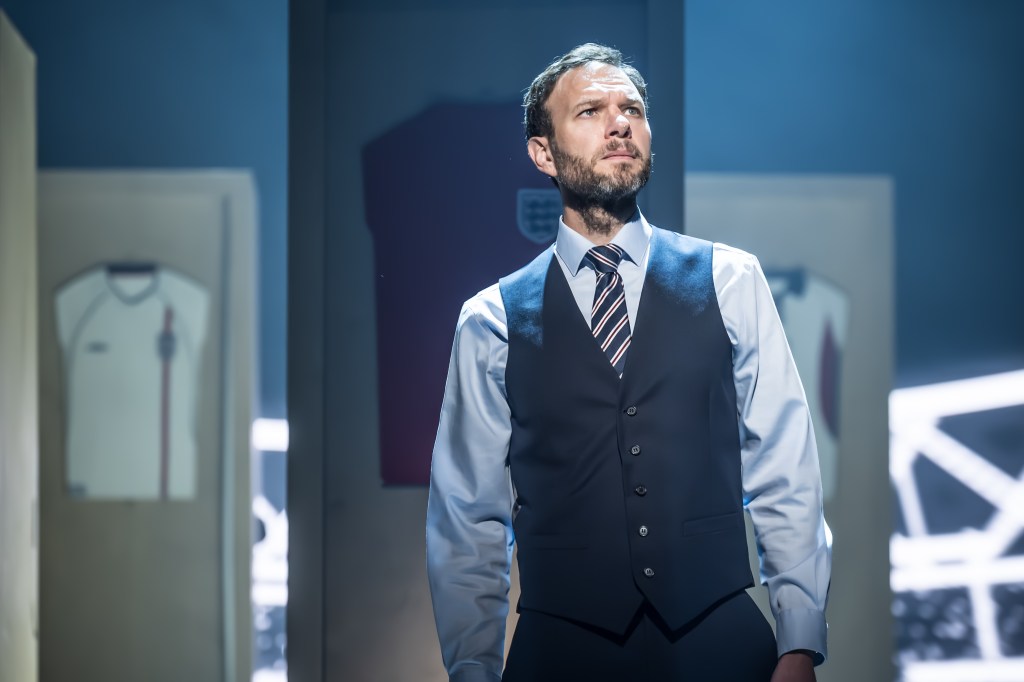
David Sturzaker as Gareth Southgate
The problem with a play of this sort, is that if you have the knowledge to understand a lot of the dialogue, you also are aware of the results of the matches referred to, or reenacted, so the basic plot is no mystery. As one of the nubs of the piece is England’s legendary lack of ability in winning games in a penalty shoot-out, even those become a given. The participants, from the manager, players, trainers and commentators; to the prime ministers who were in charge during Gareth Southgate’s watch, are depicted by impressionists, all extremely competent actors, but the liberal doses of humour injected into the production, made them caricatures rather than characters. Having said that, it did make the intense scenes appear more powerful in contrast.
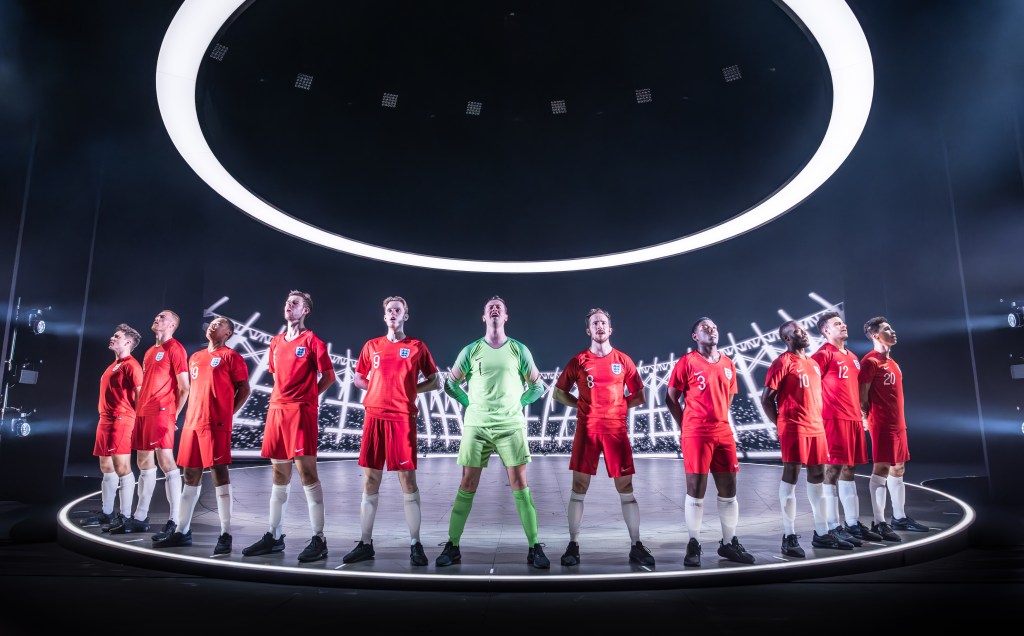
National Anthem time.
I won’t delve too much into the specifics because, if you know, you know, and if you don’t you probably won’t be very interested. Save to say that between 1988 and 2006, Gareth – now Sir Gareth – Southgate made 503 appearances as a player for Crystal Palace, Aston Villa and Middlesbrough also gaining 57 caps for England. In that last capacity he missed a penalty in the shoot-out against Germany in the 1996 UEFA Euros semi-finals, denying England a place in the final. After retiring as a player he went back to Middlesbrough in 2006 as manager, a post from which he was controversially sacked in 2009. In 2013, he was appointed manager of the England under-21 side and in 2016 promoted to interim full England manager following the sudden resignation of Sam Allerdyce who had become embroiled in a corruption scandal. His position was made permanent two months later. He led the team to the semi-finals of the 2018 World Cup, third place in the 2018-19 UEFA Nations League, the final of 2020 UEFA Euros – which they lost on a penalty shoot-out, quarter-finals of 2022 World Cup and losing finalists to Spain in UEFA Euros 2024 after which he resigned. I am sorry to have made this seem rather dry, but, when dealing with any sport, statistics speak louder than performances.

Samantha Womack, as psychologist Pippa Grange, tries to convince a sceptical group of players that there is another way.
The crux of the play was not the tactics and games per se, but the management style and the way in which the attitude and wellbeing of the players as individuals were taken into account. What Chris Simms, the former NFL player likes to describe in the PFT Live podcast with Mike Florio as, not so much the Xs and Os as the Jimmys and Joes. To this end he retained the services of a psychologist, Pippa Grange, played by Samantha Womack, who analysed the reason for the disastrous penalty taking record and transformed the way in which they approached the process. Apart from Ms Womack and David Sturzaker as Gareth Southgate, along with featured team members, this was an ensemble piece and as far as I can gather, they were all true to character as well as representing the various attitudes displayed by men from disparate walks of life when thrust together in a pressure situation. Some wanted to concentrate purely on traditional training methods whilst others were open to the new regime.
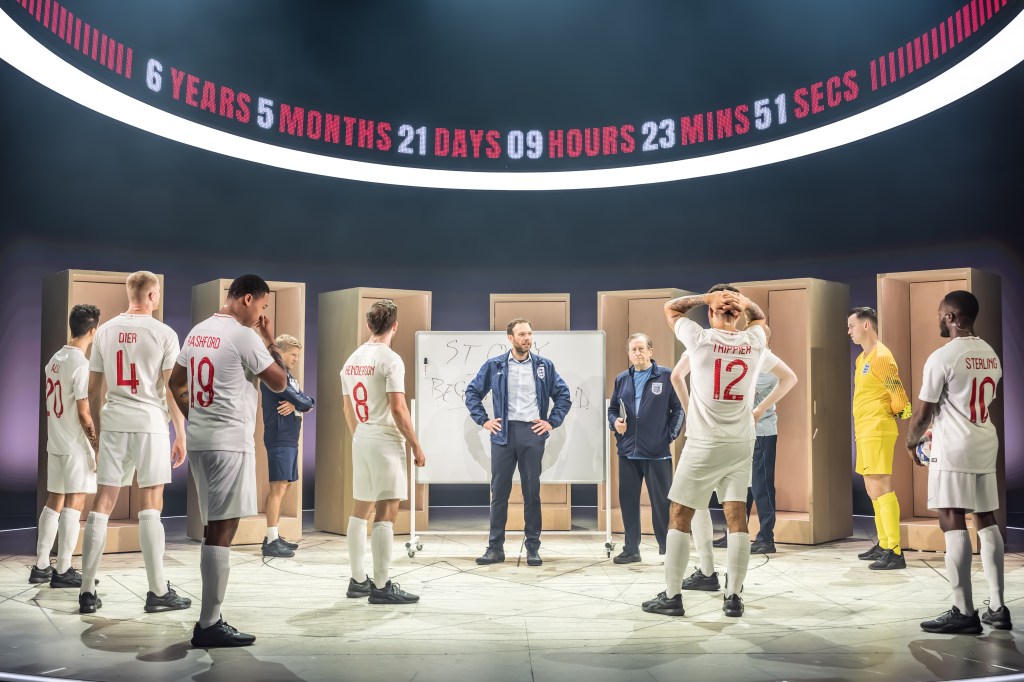
An early team talk with the countdown clock showing how long it is to the 2022 World Cup, their ultimate target.
The actors playing peripheral roles took several parts as diverse as Boris Johnson, George Rainsford; Greg Dyke and Graham Taylor, Ian Bartholomew; Sam Allardyce and Fabio Capello, Steven Dykes; Alex Scott and Theresa May, Courtney George with Ian Kirkby doing Sven-Göran Eriksson and a brilliant Gary Linekar, complete with a bag of Walkers Crisps – he also reenacted is famous gesture to the sideline when Paul Gascoigne broke down in tears after being booked in the 1990 World Cup semi-final, except this time it was Theresa May who was in meltdown!

Proper training.
The subjects of male mental health and racist abuse of players by the crowd were handled brilliantly and sensitively, giving the work a deeper meaning than just being a chronicle of the England football team between 2016 and 2024.
The direction by Rupert Goold, of James Graham’s script, was very inventive with superb contributions from Es Devlin whose set was simple but effective, using roll-on roll-off cabinets to depict the changing room, otherwise there was just a penalty spot in the middle of the stage and a large white light halo above it. This enabled video designer Ash J Woodward to create a range of effects to evoke various cities and stadia when the matches were taking place. There was also information pertinent to the action displayed on the halo.

The cast in jubilant mood.
If you are a football fan, you will probably get a lot more out of this show than if you aren’t, but, as a piece of entertainment it holds its own against many of the ‘straight’ plays I have seen performed.
Dear England is at Leeds Grand Theatre until 8th November, 2025. For more details and booking please go to https://leedsheritagetheatres.com/whats-on/dear-england-2025/ and to see what else is coming it is https://leedsheritagetheatres.com/whats-on/?theatre=leeds-grand-theatre
Feature image from Leeds Grand Theatre. Photographs by Marc Brenner.

